Tag: Productivity

  • Beginning C++ 93-100: Characters and Strings

    Characters and Strings… We have worked some with it so far, but just really putting the strings out there for the user to read and then reading in a single character or number.

    I guess we will learn more about what you can do with strings in this chapter. I just watched some video saying that C++ didn’t have strings, so I’m a little confused though. But I hope everything will be more apparent after watching this chapter of the course.

    blur close close up cord
    Yes, these are strings

    Lecture 93: Section Overview

    This section shows the legacy of C in C++. We will work with both C-style strings and C++-style strings and learn the difference between them

    The instructor does advise us to use C++ strings, so I guess that C++ has some aces up its sleeve when compared to the older C. The instructor hints to C++ strings being objects, so I think that’s where some of the difference lies.

    Lecture 94: Character Functions

    The header-file cctype includes several functions for working with characters. You can test characters for several properties. For instance, you can check if the character is a letter or a digit, or if it’s lowercase or uppercase.

    It also has functions for converting characters to lowercase or uppercase that are very handy.

    I’m a little bit confused about these though since I used tolower() in the last section challenge, but I did not include the cctype header. I tried googling an answer for this but was unable to find any, so I’ve asked it in the Q&A-section for the video.

    Lecture 95: C-Style Strings

    C-style strings are just an array of characters in contiguous memory that is terminated by a null character. This means that a string uses at least one memory space more than is shown on screen since the last character is used by C++ to determine where the string ends.

    This can lead to problems if you treat it like a regular array, as the termination character is a valid memory space and you won’t get any errors or warnings from the compiler if you try to change it.

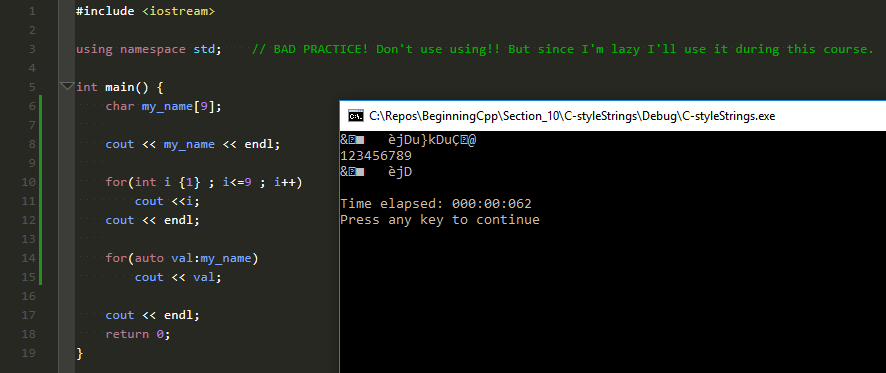
    I made a small program showing what can happen if you don’t treat strings with care. I declared a char-array with 9 spaces and printed it. I then made two for loops to write out the numbers from 1 to 9, just to make it easier to see the characters, and then I printed each character by itself, looping through the array with a range-based for loop.
    Section 11_95 - fig 1

    As you can see, the first string printed is much longer than the contents of the array, and that’s because there was no termination character inside the array. Had I been unlucky, the printout might have been much, much longer. It could also have ended on the first character. We just don’t know, as the contents of the array are undefined, precisely like Franks mentions in the video.

    All C-style string functions in the cstring and cstdlib header files expect a null termination character, so it’s easy to see that you really must know what you do when working with these kinds of strings.

    Programmers are smart, so they have known how to do this for a long time, but according to the instructor, many of these problems have been solved with C++ style strings. If you ask me, that sounds like the smarter thing, have the language take care of the behind the scenes stuff and let the programmer write code.

    Lecture 96: Working with C-Style Strings

    This video is going through examples on how you write code using C-style strings.

    The instructor starts with some code showing the same I do above, but I think my example shows it better. 😊

    But I’m not putting too much effort into this lecture, as the instructor told us to use C++ style strings mostly, so I’m waiting for that in the next part. But I guess it’s important to know this style since there’s probably a lot of code using strcpy() and strcmp() out there.

    Lecture 97: C++ Strings

    I watched a video from 2016 on YouTube that said C++ doesn’t have strings. And now I watch this video where Frank says that C++ has a large and complex string system. But maybe the first guy meant it wasn’t C++ proper since it’s in the STL. If you ask me though, it’s strange not seeing the Standard Template Library as a part of the language.

    The C++ strings are object-based, so they fit into the style of C++ with the ability to use standard operators, member functions, etc. The easiest way to describe it is that it’s similar to using arrays or vectors. Both can more or less do the same, but one way is just keeping with using the old C-functions while the other way is using modern object-oriented programming.

    That means that if you go the C++ way, your strings will behave like objects and have member functions that you use on them. When you declare a string variable, it’s always initialized for you, that means no risk of printing out garbage content to the screen if you forget to do it yourself. They are also dynamic in that they can grow and shrink in size. And maybe most important, they are safer to use. The functions use bounds checking, so less risk putting data into unknown memory space.

    All in all, I will say that the looks easier and safer to use than C-style strings.

    Lecture 98: Working with C++ Strings

    Not surprisingly, this video is the instructor going through examples of using C++ style strings.

    I must say it’s much clearer using C++ style than C-style strings. Probably because I don’t know C. But if you don’t know C, you have to agree it’s much easier to understand s1 = s2, than it is to understand strcpy(s2, s1).

    Of course, in C-style, you know that you are copying strings, while in C++ you’re really not sure what types you’re assigning to each other. But with proper variable naming, that shouldn’t be a problem.

    The instructor also shows us that other significant advantage of using the object-oriented style of C++. For instance, the functions do bounds checking for you, so you will never walk yourself out of a string using a poorly constructed loop.

    Lecture 99-100: Section Challenge, Solution, and Quiz

    A pretty cool challenge in this section. We’re essentially making a decoder ring. 😊

    When you look at it, you might think that it must be very complicated to make an encoder and decoder. But then you look at the problem, break it down into parts and realize that it’s surprisingly easy. And C++ gives you all the tools you need to solve this problem.

    All in all, the program I wrote was about 40 lines. I’m sure you can make it much shorter with some effort.

    I loved this challenge since I’m a crypto nerd. Not like in the coin stuff but like secret messages. I think I’ll need to try to implement more ciphers in C++ and the Vigenère cipher for sure is something I need to work on.

    Assignment 1: Challenge Assignment – Letter Pyramid

    In this section, the instructor has also added a new kind of challenge or assignment for us. This time we need to get a string from the user, and we will then make a letter pyramid out of that string.

    I learned that it’s important to break a problem into parts. At first, I was at a loss, but it got more manageable when I identified the three elements of the problem.

    1. Print padding
    2. Print the correct number of characters starting from the front
    3. Work back through the string from the position in 2 and print each character as you go

    Then it was just a case of solving each small task, and it went somewhat easy from there.

    It’s not the prettiest code, but it works. 🙂

    What’s cool with this is that after you submit your solution, you get to see the same problem solved by three other students in the course. I must say that the answers I saw are wildly different. That also taught me a lot, since at least one of the students solved it in a brilliant way that I didn’t even remotely think about when I worked on the problem.

    And as usual, go to GitHub for my attempt at writing some C++ code.

     

  • Beginning C++ 82-92: Controlling Program Flow, part 2

    Let’s continue our journey through controlling the program flow in C++.

    Last time it was all about evaluating an expression and doing stuff based on the result. Our four weapons to do that was the if-statement, the if-else statement, the switch-case statement, and the conditional operator. Frank also snuck in some learning about blocks, indentation, and scope.

    In this second part, we will go through different kinds of loops and end with the section challenge and quiz.

    cable rope loops
    We’re going all loopy!

    Updated 20180730:
    Updated lecture 90-92 to reflect that I’ve now done the challenge and uploaded the result to the repository.

    Lecture 82: Looping

    C++ has two or four different types of loops, depending on how you look at it. Frank says three in the course, but I’ll stick with my claim of two or four.

    The first is a for loop which iterates something X number of times. This is a very common loop, and I have already used it in some of my code examples in earlier sections.

    Then there is a variant of this, the range-based for loop, where you, for example, go through all the elements of a vector. If you remember I used a for-based loop to do this in the section about arrays and vectors. If I had known about this type, I would have used that instead. But that’s what the course is for, learning something new.

    The third one is the while loop, which has a variant in the do-while loop, so altogether four types of loops.

    The difference between the while-types is that the while loop checks a condition at the beginning, while the do-while checks at the end. This means that a while loop may never do the code inside of it, but the do-while variant will execute the code at least once.

    Lecture 83: for Loop

    22-minute video? I thought for loops were easy… This video is actually full of information, not only on how to write a simple loop.

    Of course, he shows you that, but we are also taught how to use the modulo operator for checking specific values in a loop. He talks about the conditional operator again. He speaks more on the importance of formatting your code and how, in some instances, the compiler will help you by showing you warnings. You learn about the comma operator for using multiple variables in one loop, and he also quickly mentions how to create an endless loop.

    So as you understand, this lecture is chock full of examples. Some shown on slides, but again I like that most of them are practical examples in CodeLite. It’s all pretty straightforward, but if you haven’t written code before, I really do recommend you follow along and type the examples yourself.

    There’s a neat example the instructor writes using the conditional operator we learned about just a few lectures ago. Do try to write that one yourself before you watch Frank do it. I managed to do it, but I had to think for a few minutes on how you could put an endline into a conditional operator. We have used that method before, and some of you might get it right away, but I bet some of you, like me, had to do some thinking.

    The examples also do prepare you for the exercises he has recently added to the course, so if you did the typing while following the video, you should be set to solve the code exercise easily.

    Lecture 84: range-based for Loop

    This feature was introduced in C++11, so it’s a very new function.

    It makes it very easy to go through a vector, string, array, etc. and manipulate each element as C++ iterates through the loop. And you can also use the auto keyword with the variable, making it even easier to use this.

    This loop type is really simplifying a lot of the work needed to go through a collection compared to first finding out the size, then declaring an integer to count with, comparing that int to the size we found earlier, incrementing it, etc.

    There have been some smart thinking by the C++ guys here, I must say.

    Lecture 85: while Loop

    This is the loop to use if you want to test an expression before you run the loop code. This means that sometimes the code in the body of the loop will not run even once.

    You check a condition, and if it’s true, you run the code in the body of the loop. Then the check is rerun, and you either run the code, and the cycle continues, or you end the loop.

    It’s therefore critical to change the variable you check in the loop body. If you don’t do this, you might end up with an infinite loop.

    Lecture 86: do while Loop

    You’ll use this version of the while loop if you want the code in the loop body to execute at least once. The test will be performed after the body has finished and depended on the result, you’ll rerun the loop or jump out of the loop.

    Very similar but very nice to have both options as you sometimes do want your code to run at least once and sometimes you don’t.

    The lecture ends with the instructor writing an example of how you could make a menu selection in C++. I watched his introduction, paused the video and wrote my solution before I watched the instructor do it. I really do advise you to do this. I chose another path but got the same end result. You’ll learn so much more doing it yourself first than just watching what the instructor does and then repeating it.

    A bonus for me was that I got a bug in my code, so I had to brush up on my switch statements again to find out why the program wouldn’t do what I wanted it to. Bonus repetition for me there. YEAY!!

    And DO think about why he had to use AND not OR in the test expression. My first thought was also that he should have used an OR, so when he used AND my brows kind of met in the middle for a while. But imagine that the user types an ‘a’ and do the test expression as a mental exercise. Or on paper, that works too.

    You should end up agreeing with the instructor. And if you struggle, the answer can be found on the page about operators on cplusplus.com.

    Lecture 87: continue and break

    This was a change from the previous videos since this clocks in at under 3 minutes. But why make it long and complicated, when you can make it short and sweet?

    But I really do see that these statements can be powerful tools when used in the right places. We’ve already used break in the switch-construct to terminate and jump out of the loop.

    Continue is almost the same, but instead of jumping out of the loop, it jumps back to the beginning again continuing the next iteration.

    At first, I had to think about that continue statement, as it sounds like you should use it to continue on in the program. But it got more evident when I found out that you must think of these two related to the loop you are in. You either break out of the loop and terminate it, or you continue the loop from the beginning.

    Lecture 88: Infinite Loops

    Infinite loops are just what they sound like. Loops that never ends.

    Usually, these kinds of loops are unwanted and the result of a bug or poorly designed code, but the instructor does come up with a few examples where you would want to use a loop like this. But unless you’re writing an OS or a mobile app waiting for an input, the advice is to avoid these constructs.

    Lecture 89: Nested Loops

    Now we’re back to a lengthy video again, but again it’s mostly practical examples in the IDE after the instructor first shows us some cases.

    I listened to what the instructor wanted and wrote my code before I looked at his. This means that my code is different from the instructors. His code is better designed to show nested loops of different types and the importance of proper indentation to help with readability. My source is as always viewable on my GitHub.

    This shows how easy and powerful it is to use loops. You can do a lot with just a few lines of code.

    Lecture 90-92: Section Challenge, Solution, and Quiz

    This is a whopper of a challenge. The description is 64(!) lines long.

    If you haven’t, I really advise you to download the source code for this section. That way you can have the instructions beside you while you work on your solution. You’ll find the instructor’s source code under Section 21 – Bonus Material and Source Code.

    In short, we will print a menu, and the user will select an option, invalid options should not be allowed. The other options should let the user add numbers to a list, print them and see various information about the numbers on the list.

    I streamed me working on the coding exercises and this challenge on my Twitch channel, https://twitch.tv/oldgrumpygamer. Sadly I had to remove the VOD, but it was much the same as how the instructor did it, except I used a switch statement and took four hours to do all the coding exercises and this challenge.

    I also added some code for the extra challenges in there, so I can search the list and clear it. Also added an alternate version of the add function, so you can’t add a number that’s already in the list. If you missed the stream you can find my solution on GitHub.

    I also did the quiz for this chapter on stream. Only got 8/10 right this time, I should at least have gotten 9. My tip is to read the code examples in the questions carefully. There might be a trap or two hidden there.

  • Beginning C++ 76-81: Controlling Program Flow, part 1

    I remember when I first learned to program. It was in BASIC on the good old Commodore 64. There were loads of GOTOs all over the place, and the program code was difficult to follow.

    Hopefully the functions C++ gives us is way better control and overview of the source. I suspect we will see at least some if-else statements, some for-loops, some while-loops, and even more I can’t remember right now.

    This section is even more extensive than the previous one, so I have split this section into two blog posts. That way I can push them faster to you, and they are more readable since they aren’t so long.

    If you’re interested in taking the course yourself, you can find it on Udemy.

    men working at night
    These guys looks like they have control.

    Lecture 76: Section Overview

    In the overview, we get an introduction to the three building blocks a C++ program consists of. These are sequences, selections, and iterations. With these three items, we can write any algorithm we want.

    We also get a quick review of all of the different kinds of selection- and iteration structures that exist in C++. These will be further explained in the following lectures of this section.

    Lecture 77: if Statement

    This is an 18-minute whopper of a video, but when you see it, you will understand why. In addition to introducing and explaining the if-statement, we also learn three other features of C++; blocks, indentation, and scope.

    The if-statement is a fundamental element of every program, and it merely tests if some expression validated to true and if it does, executes one or several lines of code. This is where the equality, relational and logical operators we learned about in the last chapter comes in.

    One example from real life I’m pretty sure shouldn’t need more explanation can be coded like this:

    if (traffic_light == red) 
         stop_car();

    You notice that I’ve indented the stop_car()-line. That is to make it easier for us to read the code. The C++ compiler really doesn’t care, but it makes it easier for us humans to read the code.

    But what do you do if you want to do more than one thing? That’s where blocks come in. Something it seems we have already used in this course but haven’t thought about or had a word for. A block is one or more statements encased between { and }. If you look at the previous programs you’ve written in this course, you will see that the main()-function is just such a block.

    Here’s an example of using a block with an if-statement:

    if (traffic_ligth == green && car_is_stationary == true) {
          put_car_in_gear();
          depress_gas_pedal();
     }

    One cool thing with blocks like this is that they are also what is called a scope. What this means is for example that if you declare a variable inside a block, it will only be available inside the block.

    The instructor shows all this in a practical example using four different tests conditions. I like that he writes the programs as he talks about it, even if that means we will see errors, typos, etc. I think that the lessons we learn by hearing his reasoning as he works out the program is more important than just getting to see the finished result.

    Lecture 78: if-else Statement

    This is very similar to the if-statement we saw in the last part. You just add an else-statement that will execute if the first statement is not performed. This means you can read an if-else statement as If this check validates to true the do this, else do this other thing.

    You can also expand on this with if-else-if. With several statements like those, you can do multiple checks at once.

    Again, the lecture is closed off with practical examples using CodeLite. I can’t really come up with a better case myself, so I didn’t. 😊

    Lecture 79: Nested if Statement

    You can also nest if and if-else statements within each other. You’ll probably find yourself doing this quite often, as many decisions can’t be decided by just one statement.

    But this leads to a problem, which Franks describes as the dangling else problem. In short when you have several ifs and one just else, which if-statement does the else belong to? The rules in C++ is that an else belongs to the nearest if.

    This can get very confusing, so it’s essential to use proper indentation so you can see which if belongs to which else.

    The significant part of this lecture is again Frank going through two different practical examples. I will recommend you do them together with the instructor as you will see the efficient use of the indentations.

    In the shipping calculation example, you might see a glaring omission in the input checking. I would also add a check to see if one or more of the dimensions are below 1. So I did. 😊 As usual, you can find my code for this course on GitHub.

    I’m a little sad that it doesn’t look like CodeLite is smart enough to un-indent, if that is a word, when you’re not using a code block with {}. I need to check if that can be changed somehow.

    Lecture 80: switch-case Statement

    Another 20-minute lecture. We really get our money’s worth in this section. 😊

    This selection statement is a little different as the switch statement runs a control expression and gets a specific answer that is an integer or integer literals. You then write one or more case statements, and C++ will run the one that matches the result of the switch expression.

    The syntax is very different from an if-else statement, but the instructor shows us several examples on how this works and does some live coding in CodeLite, so I feel confident I now know how this works.

    In the first example, I elected to do my checks a little different and used toupper() on the input we got from the user. That way my select statements are a bit shorter, but I guess the instructor did it the way he did as a refresher on the Boolean operators we learned about earlier. You know where to go if you want to see my code, hint GitHub.

    In the other example, Frank quickly shows us how C++ handles a switch-case statement using an enumerator. If you forget to check for all values in an enumerator and don’t include a default, the compiler will give you a warning about this. That’s a pretty neat feature, as you will then know if you have handled all the different possibilities or not.

    Lecture 81: Conditional Operator

    ?:
    No, it’s not a malformed question lacking any words, that is the conditional operator in C++.

    I’ve seen that in many C++ programs and never understood how it worked. It should be said I didn’t work hard to understand it either, nor did I do a Google search, but it does look a little bewildering.

    Luckily it isn’t, and this 10-minute video is all it takes to get to grips with it.

    It is very similar to an if-else statement and goes like this:

    (expression to be evaluated)?(return this if true):(return this if false);

    The instructor shows us several slides on how this works and also goes through a practical example in CodeLite. So, in the end, you should have a good grasp on this strange, little operator.

    End thoughts

    I will do this section in two parts since it is another long one, but before I go, I just have one more thing to say.

    When the instructor is doing his practical examples in CodeLite, listen to him, hear him out to see what he will show you and then pause the video and try to do it yourself first. You will learn SO much more by doing that.

    You might not solve it, you might do it in a completely different way or maybe precisely as Frank does it. Either way, you have learned more coding by just trying it yourself first.

    Next time I’ll complete this section and do all lectures on looping, the challenge, and the section quiz.

  • Beginning C++ 25-35: Getting Started

    So, we are now entering a new section and we are Getting Started. Yeah, that’s the title of the section, so I must believe that we are now finally going to write some code.

    norm-mac-1.jpg

    Lecture 25: Section Overview

    This is just a section overview, just as the title say. Nothing special, let’s continue.

    Lecture 26: An Overview of the CodeLite Interface

    This is a very nice video as it tells you how you can change the layout of the CodeLite IDE to your own personal preference.

    I personally didn’t change it up to much. Just removed a few tabs the Workspace view I don’t think I will be using for now and also moving it to the right side of the window. That way it looks a little bit more like my setup in Visual Studio 2017. I also fiddled around with the themes to find one to my liking and ended up using Tomorrow Night as my theme.

    Lecture 27: Writing our first program

    We write a small program to type a message to the user and get an answer from him. We started with the template we made earlier, but deleted the source and wrote everything from scratch. This is a nice educational move as it will teach you more about the structure of a C++ program when you have to write everything yourself instead of starting from a random template.

    We learn some basic input/output functions of C++ and the difference between the insertion and the extraction operator. There is a small mention of namespaces, variables and how we include libraries.

    We end up with a short little program that we compile and hopefully end up with zero errors and warnings. I managed to bork it with some missing colons, but happily nothing I didn’t know how to fix.

    The instructor also shows us that since we made our own template and based this project on that, we can see that CodeLite instructs the compiler to use the C++14 standard.

    So again nothing special, but this is Beginning C++ after all and we all have to start somewhere.

    Lecture 28: Building our first program

    We learn more about compiling and building a project. What are source-files, object-files and executable files? The instructor also goes through the different options CodeLite have for compiling, building, rebuilding and cleaning files and projects.

    The course also tells us more about the difference of the files we see in the Workspace and what is really on the disk. There are many files on the disk that we as developers don’t need to know about, at least not at this moment, but it’s nice that the course explains them anyway.

    For beginners in C++ this is maybe not fully understood right now, but it’s something you need to know when your projects gets bigger and more advanced. But we’re still in the introduction stage learning basics that are important to know to set up your workflow and understand what’s happening if something goes wrong.

    Lectures 29-33: What are different types of errors?

    pexels-photo-277052.jpeg

    These videos goes through the following types of errors:

    Compiler errors

    The instructor creates a new project and shows us some common compiler errors and some ways on how to fix them.

    Compiler warnings

    What’s the difference between a warning and an error? Well, here you get an explanation. In short, it’s not “real” errors in your program, but it warns you about things that might give you unwanted or unexpected results.

    Seems like g++ is fairly good at giving error messages and warnings that you can understand. And CodeLite also helps you find the error as if you click on an error message, the IDE will jump to the place in the code where the error is reported.

    Linker errors

    These errors are a little bit more tricky to find. A program might compile without warnings, but when you build it you might get a linker warning. These errors can be more tricky to find in your source.

    This is something we probably won’t be having much in this course since we’re doing all the coding ourselves, but when you create large projects and try to link other libraries etc this is something that can happen.

    Runtime errors

    Runtime errors are errors that happen when you’ve taken care of all the bugs in your program, compiled and built it and made the executable file. Then some user runs your finished program and gets an error and yells at you, even after all your hard work.

    These are errors that you can’t really avoid. Sometimes a user gives you strange inputs, a file can be missing or something like that.

    These errors can make your program crash, so you have to use Exception Handling to deal with them. Exception handling will be a topic for later in the course.

    Logic errors

    Logic errors are errors that the compiler won’t help you with and doesn’t stop you from building your program. These errors are made by the programmer during writing of the code.

    These errors can really only be found by doing thorough testing of the program before you send it to end users.

    Lecture 34: Section challenge

    Fairly easy challenge here as everything you need has been shown to you in the previous videos.

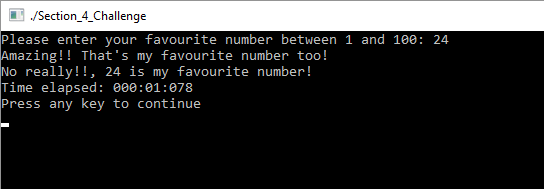
    What you need to do is to make a program that asks the users for his favourite number and get that from him. You will then say that it’s also your favourite number and confirm that the number the user typed really is your favourite number.

    s2o7pty
    This is the output of my solution to the challenge

    If you want to see my solution you can check out this gist. You shouldn’t really need to look at my solution to solve this challenge, but it’s there if you need it.

    Lecture 35: Section Challenge – Solution

    Well, not surprisingly the solution the instructor shows us are more or less identical to my solution.

    Quiz 1: Section 4 Quiz

    The section ends with a quiz with 10 questions relating to the topics covered. Shouldn’t be too hard, but it’s nice to get a review of the topics to see if you understood the material.

  • Time Management & Productivity course review

    So, the time has come to do a review of the Udemy course Time Management & Productivity.

    What is important is seldom urgent and what is urgent is seldom important.
    – Dwight D. Eisenhower

    The course is designed to get you better at scheduling and managing your tasks using a method called the Eisenhower Decision Matrix. It’s a fairly short course, so I went through all of it in an evening. And these are my thoughts about it.

    pexels-photo-908298.jpeg

    This course is a hard one to rate fairly for a couple of reasons.

    1. It’s short. But does short mean something is bad or of no value? Of course not, sometimes a 10 second pep talk can be all you need to get something done.
    2. The material is very well known. Search on Google for “Eisenhower Decision Matrix” and you get 148 thousand hits.

    But I’ll make this article pretty short also and say that I’m a little “meh…” about this course.

    First reason for that is the cost. They want $49.99 for it, which is WAY to much. I got it on a sale for $10, which I think is the maximum I would pay for this course.

    Second, but more importantly is the content of the course. They explain every part of the matrix and how to use it, but I feel that they could have done a better job of giving real life examples of the topics.

    There is a video in there which is labeled “Personal Example”, and I’m sure it IS a fairly real example from the instructor. But all he ends up with is to repeat what has already been said on the previous videos.

    If you want to learn about this topic and try it out I would recommend you start with this article from The Art of Manliness, The Eisenhower Decision Matrix: How to Distinguish Between Urgent and Important Tasks and Make Real Progress in Your Life.

    There is one thing the course does better than that article and that is it’s methodology of HOW you define which of your tasks goes where. In short how they do it is:

    1. List all your tasks
    2. Rank them first by Urgent or Not Urgent
    3. Rank each block into Important or Not Important

    And one HUGE point about that 3rd step is that you rank them on the importance FOR YOU! Does the task help you further your goals or is it a task that help some other peoples goals? Only tasks important to you should go in the Important category.

    So to sum up, will I recommend the course? If you can get it for cheap, then feel free to do so if you feel you need more than the article I linked above.
    If you do some more Googling about the topic and think that is better use of your time, then give this course a pass. If you have some more questions about the topic, then drop a comment below and I will answer to the best of my ability.